Observed decision problem
Follow the real return path and controlling soil through every CIP phase rather than relying on a program-complete flag.
Process hygiene
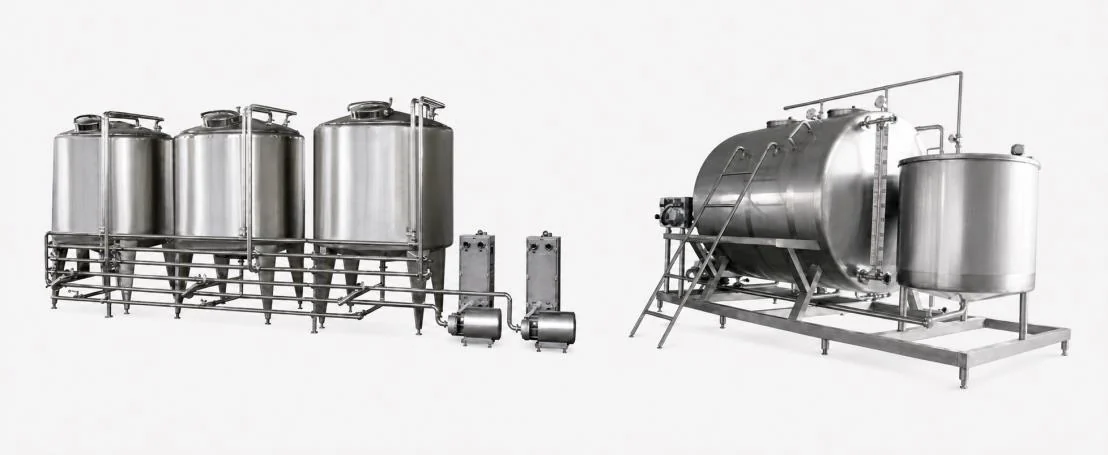
A beverage CIP system circulates specified cleaning solutions through defined product-contact circuits; it is not a universal skid that cleans every item automatically, and cycle effectiveness requires project validation.
Final equipment, layout and performance are confirmed against the project brief.
Answer first
Define the circuits, soil/product, cleaning sequence, solution preparation, temperatures, flow/return conditions, recovery policy, controls and equipment boundaries.
Circuit map
Tanks, pipes, mixers, heat-treatment equipment and fillers can require different flow paths and cleaning conditions.
Cleaning basis
Caustic, acid and hot-water procedures are configurable references. Concentration, time and temperature must follow the validated product and plant hygiene plan.
Production schedule
CIP tank volume, pumps, heating and sequence affect both cleaning effectiveness and lost production time.
Problem-to-evidence handoff
A completed recipe is not proof when flow, temperature, chemical concentration, routing or spray-device action did not reach the controlling location.
Follow the real return path and controlling soil through every CIP phase rather than relying on a program-complete flag.
Close the issue only when the defined circuit repeatedly meets process endpoints and the approved hygiene verification method.
Use the single-symptom guide when the failure is already known: Unstable CIP return conductivity · Microbiological failure investigation
Need to verify the project desk behind this review? Visit the Allot Tech corporate website.
CIP circuit register
Each circuit needs a known path, process-soil basis, supply and return condition, production window and validation owner.
| Circuit question | Record needed | Engineering use | Project output |
|---|---|---|---|
| What is cleaned? | Equipment, pipework, valves, instruments and start or end points | Establishes the physical circuit and excluded dead ends or manual items | Approved circuit list and boundary drawing |
| What product soil is present? | Beverage family, ingredients, process condition and fouling observations where available | Supports selection of a project-specific cleaning program by the responsible specialist | Declared soil basis and recipe owner |
| What must circulate? | Circuit volume, required flow behavior, pressure limits and return route | Supports pump, tank, pipe and return-interface review | Supply and return design basis |
| How is the cycle sequenced? | Production plan, cleaning stages, drain or recovery policy and available time | Determines tank duties, heating, resource demand and downtime | Controlled sequence and production handover |
| Which circuits can run together? | Simultaneous demand, shared lines, valve paths and utility limits | Prevents conflicting paths and unsupported central-skid assumptions | Concurrency matrix and interlock requirement |
| How is the endpoint observed? | Project-defined concentration, temperature, flow, time, conductivity or rinse evidence as applicable | Defines instrumentation and record requirements without prescribing universal values | Measurement and record plan |
| Who validates effectiveness? | Product, plant and regulatory responsibility plus test method | Separates equipment function from hygiene or food-process validation | Named validation owner and acceptance boundary |
Cleaning-system boundary
Combining these three layers under a generic CIP label hides important project responsibilities.
Map the actual supply and return path through every included product-contact module.
Fit preparation, filling and cleaning demand into one feasible operating schedule.
Define who establishes the cleaning recipe and who verifies that it is effective for the product and plant.
CIP definition brief
The same named skid can represent very different cleaning coverage and production downtime.
Illustrative scheduling example
A proposed line has preparation tanks, a heat-treatment loop and a filler, but the request says only that one automatic CIP system is required.
Preliminary resultThe CIP scope becomes a set of controlled circuits and operating handovers instead of an unsupported promise that one skid cleans everything automatically.
Illustrative only. No chemical concentration, temperature, time or hygiene outcome is prescribed.
Evidence boundary
Evidence labels keep a reference architecture separate from a final design or commercial promise.
The supplied 2026 catalog includes CIP as a connected part of carbonated and juice or tea process references and shows configurable CIP equipment concepts.
Circuit volume, flow path, soil basis, cycle sequence, utilities, instrumentation and production schedule jointly define a CIP engineering scope.
Final recipe, circuit performance, hygiene validation, utilities, records and acceptance criteria require product- and plant-specific approval.
Buyer questions
These are planning answers. Final process and equipment choices require a confirmed project brief.
No. CIP describes cleaning in place for defined circuits. Any sanitation, sterilization or aseptic requirement needs its own project-specific process and validation basis.
No. Circuit path, required flow and return behavior, simultaneous demand, heating, production window, recovery policy and utilities also affect the scope.
No. Each circuit needs defined supply and return routing, required flow, soil basis, sequence and equipment boundary.
No. The project can support a defined cleaning program, but effectiveness requires product- and plant-specific validation.
Catalog reference The supplied 2026 catalog supports the named CSD and juice/tea equipment chains and is the source for the redrawn functional routes.
Engineering principle Interface explanations show why product, process, package, utilities and line balance must be reviewed together.
Project confirmation The routes are not a final process design, P&ID, validated cycle, quotation, availability statement or performance guarantee. Signed project documents define the final scope.