Catalog reference
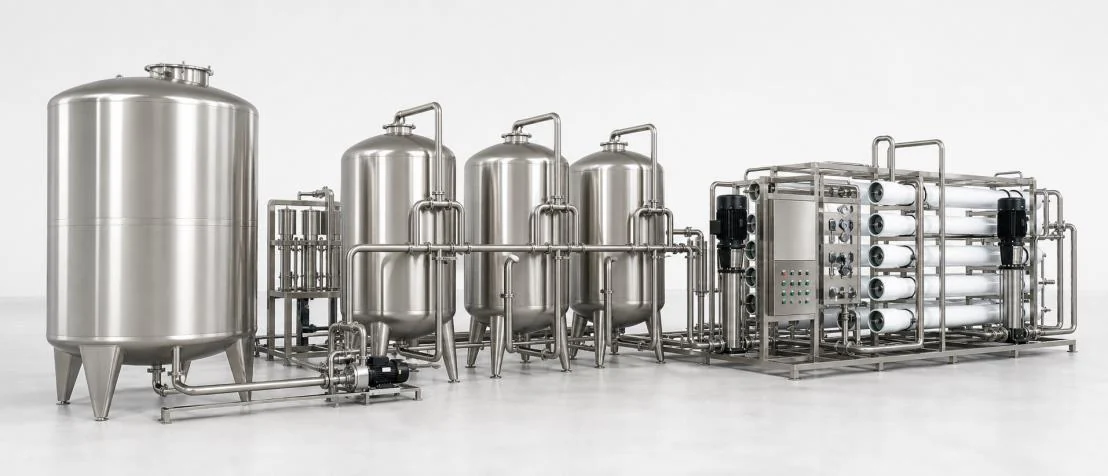
The supplied catalog includes water-treatment reference equipment as an upstream system within beverage projects.
Start with the source-water evidence
A beverage water treatment system should be designed from the raw-water analysis, finished-water use, beverage recipe, plant recovery needs and local constraints. A generic reverse-osmosis skid is not a complete water strategy.
Final equipment, layout and performance are confirmed against the project brief.
Answer first
Begin with representative raw-water data and separate the required water uses: product water, ingredient water, final rinse, cleaning, boiler or cooling make-up and other utilities. Establish the quality target and applicable process or regulatory basis for each use, then develop pretreatment, membrane or other treatment, disinfection, storage, distribution, monitoring, waste and recovery boundaries. Capacity must include peak demand, regeneration, cleaning and realistic recovery—not product bottles per hour alone.
01 / Water basis
Source type and variability, chemistry, microbiology and seasonal conditions should be documented through appropriate sampling. Product water and plant utility water can have different quality, quantity and storage requirements.
02 / Treatment route
Pretreatment, filtration, softening, activated carbon, membrane treatment, disinfection and remineralization are conditional tools rather than a universal sequence. Each stage needs an inlet, outlet, monitoring and maintenance basis.
03 / Plant integration
The water system must supply simultaneous production and cleaning loads while allowing for backwash, regeneration, membrane cleaning and maintenance. Drainage, concentrate, spent media and chemical handling belong in the factory scope.
Water-use register
One plant can require several water conditions and demand profiles.
| Water use | Basis to confirm | System impact |
|---|---|---|
| Product water | Recipe and finished quality target | Treatment, storage and hygienic distribution |
| Final rinse | Container and process requirement | Quality, flow and point-of-use control |
| CIP water | Cycle, circuits and simultaneous demand | Peak load, heating and recovery |
| Boiler/cooling make-up | Utility equipment requirement | Softening or other conditioning may differ |
| Waste streams | Reject, backwash, drains and chemicals | Recovery, disposal and site permissions |
Evidence boundary
Evidence labels keep a reference architecture separate from a final design or commercial promise.
The supplied catalog includes water-treatment reference equipment as an upstream system within beverage projects.
Treatment selection follows source-water evidence, required use, peak demand, recovery and site integration.
Final water quality, process, capacity, recovery and compliance require approved analyses and local project criteria.
Buyer questions
These are planning answers. Final process and equipment choices require a confirmed project brief.
No. The required treatment depends on raw-water condition and the target use. RO may be suitable for some projects but should not be selected without a water analysis and product basis.
Usually that comparison is incomplete. Preparation, rinse, CIP, backwash, regeneration, storage recovery and simultaneous utility demands must be included.
Provide representative raw-water reports, source and seasonal information, required water uses and quality targets, production schedule, cleaning plan, site utilities, drainage and local requirements.
Catalog reference The supplied 2026 catalog supports the named CSD and juice/tea equipment chains and is the source for the redrawn functional routes.
Engineering principle Interface explanations show why product, process, package, utilities and line balance must be reviewed together.
Project confirmation The routes are not a final process design, P&ID, validated cycle, quotation, availability statement or performance guarantee. Signed project documents define the final scope.
Allot Tech project desk
For a useful first reply, send the beverage, package, target good output and factory. If a line is already operating, add the observed symptom, first-known-good and first-known-bad time, affected SKU, photos, alarms and available production data.
Company verification: visit allottech.com.